Sunday, December 3, 2023

War of the Worlds (1988)

Note: As of 22/03/2025, Bill Sturgeon himself kindly lent me several scans of photos he took during his time on the series (as well as concept art sketches that will be posted on another article at a later date). I would like to publicly thank Sturgeon for being so kind!

Influenced by the early 80s series V, the 1988 adaptation of War of the Worlds was a more gruesome update on Wells' original text, as well as a sequel to George Pal's 1953 adaptation. Producer Greg Stranghis described the show's ethos; 'We're working against the idea that all intelligent life in the universe is like E.T. Our aliens will definitely not be pleasant'.

Strangis however, was adamant that it was not a horror series, despite its violence; 'I don't want this characterized as a blood and gore show. Even the term 'graphic' is a dangerous word. The show will have effects, it is is also a series that my 12-year-old must be able to watch. This series will have a tendency to be emotionally violent. We will be dealing with action and violent death. But that doesnt mean we're going to have blood and guts all over the screen.'

The series makeup effects were handled by Bill Sturgeon, assisted by Francois Dagenais and sometimes Jacques Fortier and Randy Daudlin. Some of Sturgeon's first makeup jobs on the series were the alien-possessed zombies. Sturgeon explained;

'Doing the zombie makeup has been a particular kick. It's not just the typical rotting flesh sort of thing that everybody has seen a million times. When an alien has been in a human body for a while, parts of its features begin coming through the human body, which has allowed me to do more subtle things'.

A variation of the decaying zombie makeup was made for another episode, with the appliances containing air bladders to appear as if the flesh was bubbling.
Sturgeon's team also made the alien hybrid prosthetics in the episode 'Unto Us a Child is Born'; the prosthetic was designed to have a flattened face and enlarged cranium.
Several makeups were also made for the mutant child's rapid aging and decomposition, which required versions of the mask that were aged and skeletal.
Much of Sturgeon's work on the series was on the various death scenes, which required several dummy heads and assorted body parts to be made; most elaborate was the exploding head of a bloated depressurized body.

The the exploding head dummy was sculpted by Sturgeon, and painted by Dagenais. The open skull head was also sculpted by Dagenais, and based on a cast of Fortier.

Of course, the most elaborate death effects were the meltings that happened whenever an alien-possessed human was killed; in most episodes this was achieved by the special effects department, but sometimes Sturgeon's makeup effects team had to create more elaborate deaths with layers of translucent vinyl.
In the series, the alien-possessed humans could shoot out an alien hand out their torso. This was achieved by Sturgeon's team as a fake torso through which the alien hand was puppeteered. Several alien hands were also made for close-up shots.
A test photo of the third arm fake torso gag.

Of course, the aliens - who in this version of the story came from another planet - had to appear. Sturgeon at first wished to follow Wells' description of the aliens in the origninal novel but the producers insisted he homage Albert Nozaki's design for the George Pal film.

Strangis explained; 'We only plan on showing bits and pieces of the aliens. We don't plan on ever showing an alien full-on. We don't want to lose the mystery of our monster. But they are definitely more horriyfing. We havent skimped on their lack of beauty.'

For close-up shots of the aliens attacking, an animatronic puppet head was made, that could move its eye around.
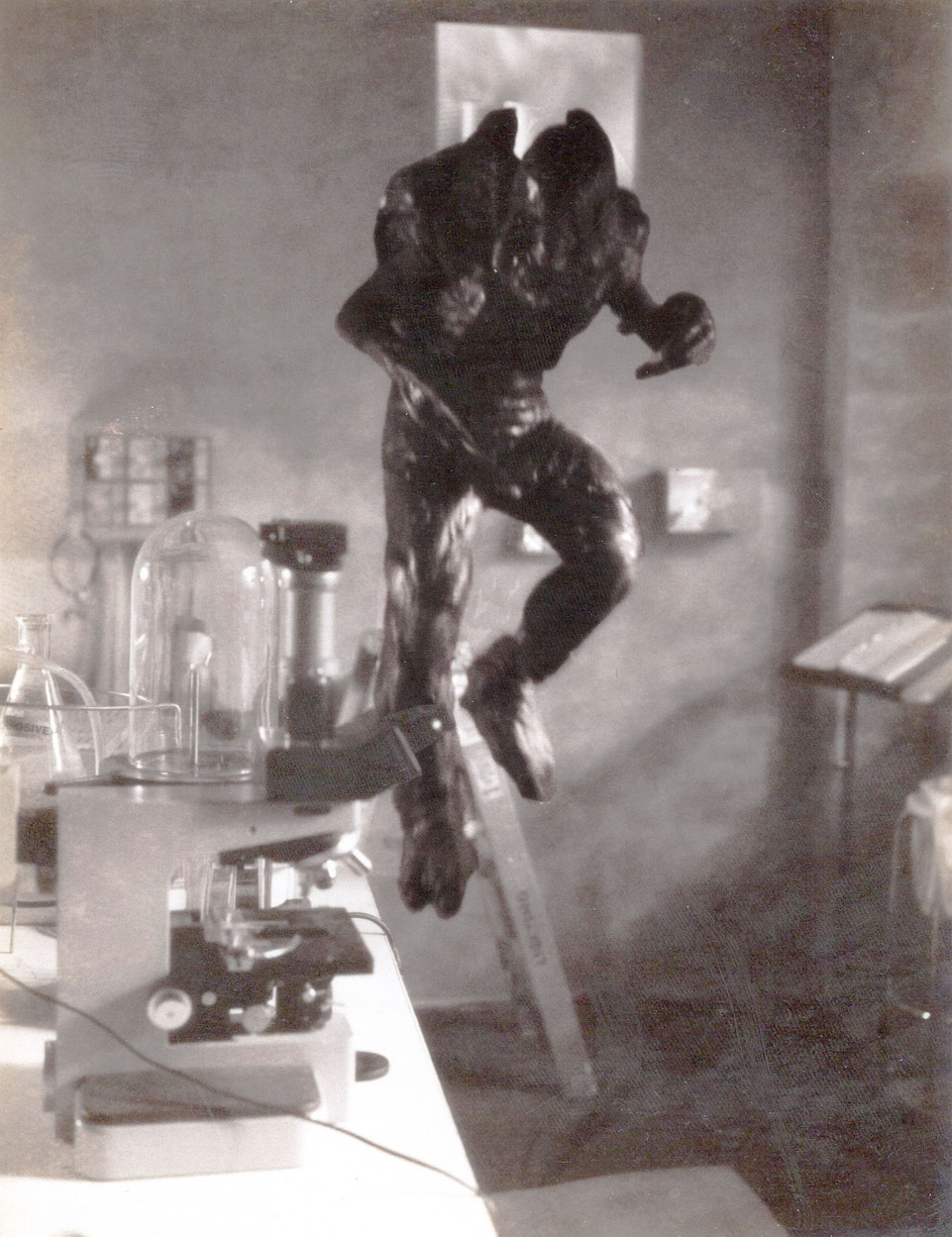
The aliens were not to be seen past shots of the head and arms, but some scenes required a full alien body; Sturgeon in emails said that it had to be quickly made, and that the paintjob was Dagenais' work. The suits' hands and heads were reused in the second season.
The back of the alien's suit being sculpted.

Sturgeon's work continued on the second season with 'the Eternal', the aliens' deity. It was a puppet with a blinking eye mechanism, and was suspended on a seesaw-like rig. I wonder if the Eternal was Sturgeon's attempt to do an alien closer to Wells' description.

Andrew Kenworthy was credited as prosthetics designer for the second season, but generally the season had little to no makeup effects, past a shrivelling skull effect in the finale episode.
Maquette sculpt of the Eternal

Sources:

  • Cinefantastique Vol. 19 No 1-2 (1989)
  • Starlog #133 (1988)

SeaQuest DSV (1993)

The creature effects for SeaQuest DSV were realized by Tony Gardner's Alterian Studios, which was oddly uncredited in each episode's ending credits. The humanoid aliens appearing in 'Such Great Patience' and 'The Fear That Follows' were designed to be androgynous, with domed heads and pronounced shoulders; onscreen this was realized as a bodysuit and prosthetic makeup.
The more fierce looking 'Stormer' aliens in 'Dream Weaver' were also prosthetic bodysuits, with a mask worn over the performer's head; noticeably, the two Stormers are only distinguished by the evil one having a topknot fitted on its mask.

Friday, November 24, 2023

Lexx (1997)

Lexx was shy on creature effects, partly thanks to series creator Paul Donovan's drive to differentiate the series from contemporary science-fiction series. Lexx co-creator Lex Gigeroff quoted Donovan as saying, 'No shell-heads! Either you're human, or very far from human'.

Donovan also had a rule against 'rubber monster suits' which influenced the design of the ravenous 'Cluster Lizards' seen in the first season. Production coordinator Cordell Wynne stated 'We're looking for a real edge in the designs. We want to break new ground with monsters. We have to avoid cliches. Paul Donovan said 'no rubber suits', so we asked ourselves 'what hasn't been done before?' Rubber suits have, but a rolling lizard hasn't.'

The Cluster Lizards were a collaboration between David Albiston's Albiston Models & Effects and Colin Penman's MAD (Makeup, Art & Design) Company; the former primarily handled the miniature effects, while the latter the physical puppets.

Artist Mark Laing designed the Cluster Lizards on paper, and David Albiston sculpted maquettes to visualize the colourscheme for the puppets and CG models.

A photo found online - are these Albiston's Cluster Lizard maquettes?

Penman's MAD team then fabricated the Cluster Lizard puppets. The puppets were built in Toronto, and then shipped over to Halifax, Nova Scotia, where Lexx was filmed.

Two life-sized puppets were made for shots that required them to interact with the actors. The large puppets had servo mechanisms inside that controlled the 'antennae' and jaws.

These puppets were basically worn by the puppeteers like costumes. Michael Peterson, one of the puppeteers, recalled 'To be honest, I hated that part of the job. I was blind, I was deaf and it was a ridiculously heavy piece of equipment, I couldn't manipulate it very well.'

Wynne explained about the design 'The lizards have an intentional grotesqueness about them that will hopefully hit an emotional edge with the audience. Science fiction is such a well-travelled genre, it's hard to find new things to do.'
Two miniature puppets were also fabricated by Penman's MAD team, used in quick shots where neither digital effects nor the cumbersome life-size puppets were viable. One of the smaller puppets was also used to represent the 'baby' Cluster Lizard named Squish
A test model for the miniature puppet?

These smaller puppets were basically glove puppets. For the shots of a horde of Cluster Lizards in cages, digital editing was used to make it appear there was more than two.

Peterson explained about the Squish puppet, 'A plunger opens and closes his jaw. It's actually fairly hard to do, as he's not very flexible. But we only use it for quick shots, so he works for that. We can't even make him talk, but he doesn't have to talk, he just makes sounds!'
A 'bottom end' of the Squish puppet must have also been made for the shot where it writhes around in the Gigashadow's brain in 'Gigashow'.
The second season's opening episode 'Mantrid' required many shots of the cast interacting with a survivor of the Insect Civilization. The Insect was realized mostly as a life-size puppet, built by Chris Kunzmann, credited under his company name Chris Creatures.

The puppet had mechanisms inside that controlled the mouth and eyes, and could be operated to make it appear as if the creature was shuddering awake.

I assume the brief shot of the Insect falling into the water was achieved via a miniature effect, presumably supplied by Albiston Models & Effects.

(Amusingly, the 'Mantrid Build' prop, for the cyborg body of the titular scientist Mantrid, is credited both to propmaker Alexander Dammeyer, and 'dead chickens'. Presumably bought butcher shop chickens were used to simulate Mantrid's organs inside the prop...)

Kunzmann also supplied the prosthetics for Zev's Cluster Lizard transformation in the following episode 'Terminal'. The prosthetics were blended together with digital 'morph' effects making it hard to tell what was made, but Kunzmann has posted the mask on his social media accounts.
Not quite the nudity most pervy viewers wanted!.

Mark DeLuca was credited for special makeup on the episode 'Woz', creating a disfigured head appliance for Lenore Zann as the 'Dark Lady'.
The only other Lexx episode with elaborate makeup effects was the fourth season's 'Viva Lexx Vegas'. The mummy makeup was handled by Aaron Peerless and Greg Corbin's Phantom FX.

Sources:

  • Assorted behind the scenes featurettes
  • Parsec Magazine, 'Flip-side of the Prime Directive' by Mike Petersen .