Tuesday, July 8, 2025

Hellraiser (1987) - Part 2: Frank & His Victims

Continued from the Part 1 article on Hellraiser which focused on Frank's bloody resurrection.

After his resurrection, Frank Cotton would remain in most of his scenes as an undead, flayed apparition. This was a daunting task for Keen's Image Animation crew, as a full body flaying had rarely been attempted in makeup effects.

Even though Clive Barker himself had achieved a rudimentary full body flaying effect for his 1978 short film The Forbidden, it was banking on the film's grainy black and white quality to look more 'real'. Studio films generally did not have that luxury.

Stan Winston had realized a skinless burning victim for 1981's Dead & Buried by making a puppet. Craig Reardon and Michael McCracken similarly utilized puppetry to realize the face-ripping effect for 1982's Poltergeist.

Christopher Tucker's skin-ripping werewolf transformation for 1984's The Company of Wolves was also achieved via puppets, as was Peter Litten and John Humphrey's skinning victim for 1985's Underworld, which was sadly cut from the final film.

(Underworld, incidentally, was written by Clive Barker and was one of the film adaptations of his work that went so awry that it convinced him to direct his own films)

The only realistic full-body flaying achieved with prosthetic makeup by that that point was Dick Smith's skinless bodysuit for Blair Brown in 1980's Altered States; an effect that, again, never made it into the final film.

Some Asian films had attempted full-body flaying effects, with 1983's The Boxer's Omen going with a fakey bodysuit, and 1986's Guinea Pig: Devil Doctor Woman achieving a full chest and face makeup, albeit with the facial appliance being static.

What made Frank Cotton far more complex than any of the above was his many scenes of screentime and lines of dialogue, meaning that puppets, fakey bodysuits and static masks were all completely out of the question.

Keen voiced his frustrations with achieving the flayed Frank Cotton, '(Barker) convinced us, 'Oh I've done skinned people before, they're easy, I've did it for plays'. I don't think he had any idea how complex and difficult, and how involved it is sticking something on the top of someone, but making it look and feel like something's been taken away. It's a normal process in makeup, but this is amplified by ten when its a skinned person'.

There was three stages to Frank Cotton's makeups, with his first being the greyish mummified makeup he sports when newly reborn. Playing Frank in his skinned incarnations was English actor Oliver Smith, who had a lifecast taken of him for the prosthetics.

The Frank prosthetics were primarily the work of Cliff Wallace, who ironically enough had previously worked under Peter Litten and John Humphreys on the earlier Barker adaptation Rawhead Rex. Wallace recounted the inspiration for the Frank makeups;

'My main task on Hellraiser was the various incarnations of Frank, the skinned man. It was a huge learning curve as I’d never sculpted anything more complicated than a mask at this point. Clive had the coolest references too, Vesalius etchings, Joel Peter Witkin photos. Books on piercings and body modifications, stuff that was very underground then. Kind of scary and sexy at the same time. Always a potent combination'.

For the shots of Frank scrambling across the floor, a child actor wore a mask (made from the same sculpt as the Oliver Smith prosthetic) and bodysuit, to give Frank a shrunken, pathetic appearance.
The mummified Frank bodysuit's fleeting appearance in the film.

The second stage Frank makeup was his initial 'flayed' look, and was perhaps the most complex makeup in the film. Oliver Smith had to wear a full facial appliance, as well as a full bodysuit. Keen descibed Smith's ordeal;

'He went through hell. We life cast from head to toe, everybody had a go at sticking pieces together and sculpting pieces. Its the yardage as well. When you got a person, who every single inch of them is covered in either a suit that was reusable, or prosthetics (on the arms and head) that had to be replaced every single day'!

Bob Keen had a grim anecdote about how the flayed Frank makeup was researched, 'Me and Clive went to an autopsy being held in a medical school in London. And I threw up! We watched a doctor, along with a lot of students, actually skin someone, a corpse, for real. I didn't see much of it cos I was (throwing up), but Clive was kind of disappointed with the end result of the real thing. His exact words were, 'It looks like a lot of bacon's stuck on someone.'
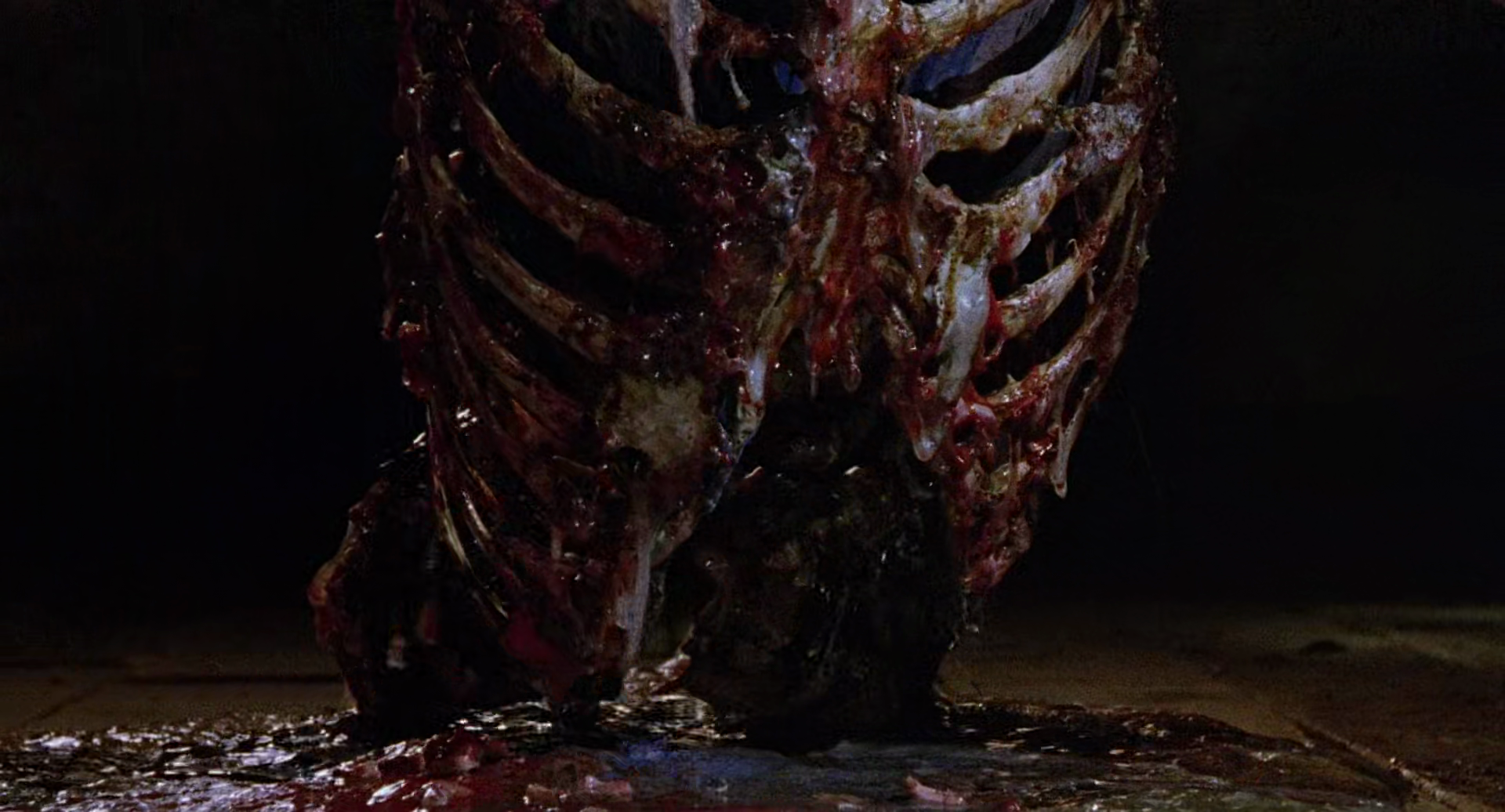
John Cormican, who worked on the second-stage Frank makeup, revealed how the ribcage was achieved, 'I worked with Cliff Wallace on the suit for skinned Frank. He had these ribs, and Bob said to me, 'Just make them out of this bit of perspex' (...) I remember thinking, 'this is insane, it will never look good, they should be sculpted!'. So I cut out these ribs (from the perspex sheet) and sanded them and tried to make them look a bit organic.

And then I made these ribs, and got to put them on with Cliff, as I'd help him with the makeup when I could. And now looking at the photographs, with the depth of his chest. When you know what it is, it just looks ridiculous, but when you don't, you notice the depth on this bodysuit.'

The third and final stage of the skinless Frank makeups was partly made by Geoff Portass, achieved as a full face mask and hand appliances. Cliff Wallace had an amusing anecdote on the final Frank makeup, 'The final stage, which was the the surface anatomy stage, which Barry Norman described as looking like a raspberry ripple!'
Image Animation also handled the film's gore, much of it at the bloody hands of Frank. A full facial appliance, with a sagging, decaying appearance, was made for the third of Frank's victims, who escapes after having been partly drained.
A dummy prop was made to depict the final fate of Frank's first victim, sculpted to have a twisted, sagging visage.
A grisly flayed corpse dummy was also made to represent the unfortunate Larry's fate. This particular prop ended up on the cover of Fangoria #67.
Note Fangoria's error; this is neither meant to be Frank *or* his resurrection!

Sources:

Read more on Hellraiser's special effects in the 'Part 3' article, covering the iconic Pinhead and his fellow Cenobites.

Hellraiser (1987) - Part 1: Frank Cotton's Resurrection

The makeup effects of Clive Barker's first feature film was handled by Bob Keen's fledgling Image Animation studio. Keen had ten years experience in makeup effects at that point; he had first worked under Stuart Freeborn on The Empire Strikes Back and Return of the Jedi.

It was during Keen's tenure on these two films that he met Nick Maley, who was also working under Freeborn. Keen became Maley's assistant on Krull, The Keep and Lifeforce, as well as working for other effects houses on The Dark Crystal and The Neverending Story.

Keen had only just set up Image Animation, together with makeup artist Geoff Portass, after they had parted ways with Maley after working under him for Highlander. Keen explained why he founded Image Animation;

'What we wanted to do was create a company that would have new blood. We'd worked a lot for a lot of people who'd been in the industry for a long time. And we felt that the industry needed an injection of new ideas. (...) I think Geoff is a really good makeup artist and I'm a really good special effects person who can solve problems'.

Keen & Portass had only been going solo for a very brief time until Barker approached them with the Hellraiser gig. Keen recalled;

'I was doing short stints on Aliens and Little Shop of Horrors when Clive called me up, having heard good things about my work. At that point I was in the process of setting up my company, Image Animation, with my partner Geoff Portass, and we were the first effects people to read the script'.

Geoff Portass confirmed 'I think with Image Animation, we'd come up with the name before Hellraiser, when we'd got the small shed in Shepperton, which was only three or four months beforehand. So we'd finished Highlander and moved to Shepperton, done a couple of small jobs for a couple of small films, and a couple of big films, but it was subcontracted work'

Keen & Portass' Image Animation crew on Hellraiser included Cliff Wallace, John Cormican, Simon Sayce, Roy Puddefoot, Paul Catling, Nigel Booth, Dave Elsey, and much more; many of these makeup artists would go on to have long-running careers.

The bulk of Hellraiser's makeup effects would go to the film's true villain, the creepy uncle Frank Cotton returning to the mortal plane as an undead flayed corpse, with additional makeup effects going to his assorted victims and his gooey resurrection.

Ironically, while Frank's rebirth is the first effects-heavy sequence in the film, it was actually filmed long after the film's other special effects and makeups had been completed, at the insistence of Hellraiser's producers at Roger Corman's New World Pictures.

Editor Tony Randel recalled how underwhelming the original cut of the scene was, 'Larry cuts himself, there's blood on the floor and then we cut away. And then Julia comes up (to the room) and there he is. And I thought, wow we're really missing a big oppurtunity here!'

Bob Keen was happy with New World's suggestion; 'This is where the American producers were wonderful. (...) They said, 'Let's go back and do some pick-ups. Let's come up with a great birthing sequence. And we started completely anew. We had the luxury of a raised stage so we could work underneath (the set's floor). We had lots and lots of puppet rigs'.

The very first stage of Frank's transformation - a shot of a beating heart under the floorboards - was achieved via very simple methods by John Cormican, who recalled;

'I remember Bob saying to me, 'I need you to build something just there' and he pointed to this stage (...) 'I need you to build a little set there, and it's gonna be where the birth of Frank is, and look a bit like an embryo. (...) So I built this little diorama and (...) with a condom with a tube that you could blow life into it!'

Frank's embryo stage.

The next stages of Frank's resurrection were to have his body reconstitute itself organ but organ, as Keen recalled, 'I found it interesting to start with bare bones and work up to something quite skinny but definitely alive, a total reversal to the usual effect where you're making someone decompose'.

Eight main stages of puppets were made for the resurrection sequence, with more appliances made to show the close-ups of Frank's organs reconstruct themselves. Time-lapse dissolves were utilized to achieve the effect that it was a continuous effect.

Keen explained, 'The brain then forms & the spinal column begins to probe it. Brain & spine become attached, & veins & skin start to appear over the bones. The eyes push out from the sockets & snap open. We used reverse meltdowns with mechanics in them. That sequence involves a whole bunch of ideas merged into one, & I don't think that's been done before.'
The early stage arm puppet.

The middle stage spine puppet.

The later stage brain-spine puppet.

Keen elaborated on how the close-up shots of Frank's organs were achieved, 'We were doing a lot of stuff with wax; we'd have the finished item, and then wax heads on the animatronic. We'd have veins made out of thread and cottin, and we'd melt the head and the wax would burn really fast. And as it would go, we would pull the veins back in. So when shot in reverse, you'd see the flesh forming up, all the different colours of the flesh, which was really nice.'

The wax close-up brain.

The close-up ribcage.

The close-up hand.

Originally, Frank's rebirth would have been achieved via three stages. The first two stages were animatronic puppets, and the third and final stage would have been a body suit. However, only one of the puppets made it into the film very briefly.

Cliff Wallace explained why the puppets barely got in the film, 'Originally Frank was bricked up behind a wall, which he falls out of and starts talking. We built a lip-syncing puppet that was just too complicated for its own good really. It was a fairly simple rod puppet with cable-controlled facial expressions, but it just took too many of us to coordinate it, and we never really got it together.'
John Cormican with the unused first Frank puppet.

Cormican also said about the Frank puppets, 'He looked like something out of a mummy's tomb. He was inside this wall, the bottom half of him. There was different animatronics we made, one where he was sat in the room, and one where he'd come out of the wall'.

The second Frank puppet's brief appearance in the film.

Sources:

  • Fangoria #66, 'Putting the Hell in Hellraiser' by Philip Nutman
  • Leviathan: The Story of Hellraiser and Hellbound: Hellraiser II (2015 documentary)

Read more on Hellraiser's special effects in the 'Part 2' article, covering the skinless Frank and gore makeups.