
The film's creature suits and prosthetics were handled by Paul Jones Effects Studio. Shaune Harrison and Kate Hill were credited as key prosthetic artists, Kelly Groh and John Kernigan as prosthetic costume coordinators, and Patrick Baxter as foam latex coordinator.
Paul Jones, who oversaw the special makeup work, remembered that Fawcett was surprisingly vague on his idea of what Ginger's gradual change would look like. Jones said;
'John really had an image in his mind for the wolf suit but when it came to the actual transformation, I don't think he'd given it as much thought. He wanted it to be a natural progression. The creature itself, though muscular, is very sickly.
As far as the transformations went, he wanted to have a 'better than Buffy (the Vampire Slayer)' look, which I found very amusing. My idea was to keep it as subtle as I could, right to the very end.
The last stage would have to appear suddenly, because Ginger is changing very quickly at that point. In the stage-two transformation, he wanted to ensure that, if she was noticed by other characters, they would think it was just a very nice, subtle makeup rather than her bone structure actually changing.'
Some of the more subtle elements of the first stage makeups were prosthetics around the eyes. Jones looked back on how these prosthetics were made in a later interview.
'We made these kind of eye pieces, to make it look like her eye socket was changing. Again this was in the days when everything was foam latex so there's certain shots that I just cringe at now, because nowadays you would do it in silicon and it would photograph so much better. But at the time we were using foam, so it was a little bit flat.'
The early stage makeups were worn with wigs made by Gerald Altenburg. The makeups were complemented by vibrant blue eye contacts made by Martin Osler, a Toronto optemetrist who specialized in special effects contact lenses.
(Altenburg would later work again with Paul Jones on the 2001 film Wolf Girl, supervising the lace 'fur' applied on Victoria Sanchez in her role as a girl with hirsutism.)


The makeups for Isabelle took between three to five hours to apply depending on complexity - the second stage transformation makeup was a full facial appliance. Isabelle said;
'It's annoying, and completely tedious, but it does help you get into the role, (...) When you look into the mirror, you appear completely different - you look like some psycho werewolf. You look at your hands, and you've got these massive gloves on, with big nails. And you can't see out of your eyes, because you have these contacts. (...) It really helped me though. Five ours with little paintbrushes at the corners of my eyes, but it did help.
'Your pretty much have to soak your face in alcohol to take it off, (...) There were these horrible chemicals, and it's not like I was taking care of my skin anyway. But now I'm completely prepared for anything. I can't imagine any other movie that has as much screaming and yelling and attacking people, and death, and prosthetics, and crying, and long hours. I'm prepared.'

In yet another interview for Sci-Fi-Online, Isabelle recounted, 'It was interesting. It took five hours to apply and two hours to remove. It was incredibly tedious to sit still for five hours while someone puts a little paintbrush in the corner of your eye. The special effects guy was really great. He would bring in a laptop for me and let me watch DVD’s.
So it wasn’t too dull. Because my whole face was covered my skin couldn’t breathe, so my nose would run constantly. As a result I had to have Q-tips stuck up my nose the whole time! I dread to think what people thought when they saw this wolf walking around with 2 Q-tips up her nose! It was fun though.'


During the party scene, Ginger was meant to strip, showing fuller breasts as well as nipples like those of a real wolf. This was achieved with a torso appliance wth fake breasts, something Jones recounted an amusing detail about;
'There was a fun day when we were doing (...) the Halloween party. She had a full prosthetic chest where we gave her new foam latex breasts and extra nipples going down her stomach. It was supposed to be a topless scene but she didn't want to be topless, even though it was foam latex! There was none of her skin showing whatsoever!It was kinda fun, we had to strategically put tape to hold her shirt at a certain angle, so it would *look* like she was topless and naked, when she actually wasn't. So even though it was rubber nipples, she still didn't want them on camera!'

There was not enough money for elaborate transformation effects, with the budget stretched thin between the werewolf suit, transformation makeups and gore.
(The werewolf seen in a mock horror movie on TV in one scene was a reuse of the Howling-style werewolf suit Paul Jones had supplied to F/X The Series a few years earlier).
Ginger's direct transformation from woman to she-wolf was achieved via prosthetic appliances, as Fawcett recalled; 'It's maybe less makeup-intensive than other werewolf films. (...) There aren't any stretching fingers or anything like that. All the transformations occur between cuts and scenes, so there are no rig cages jutting or faces contorting'.


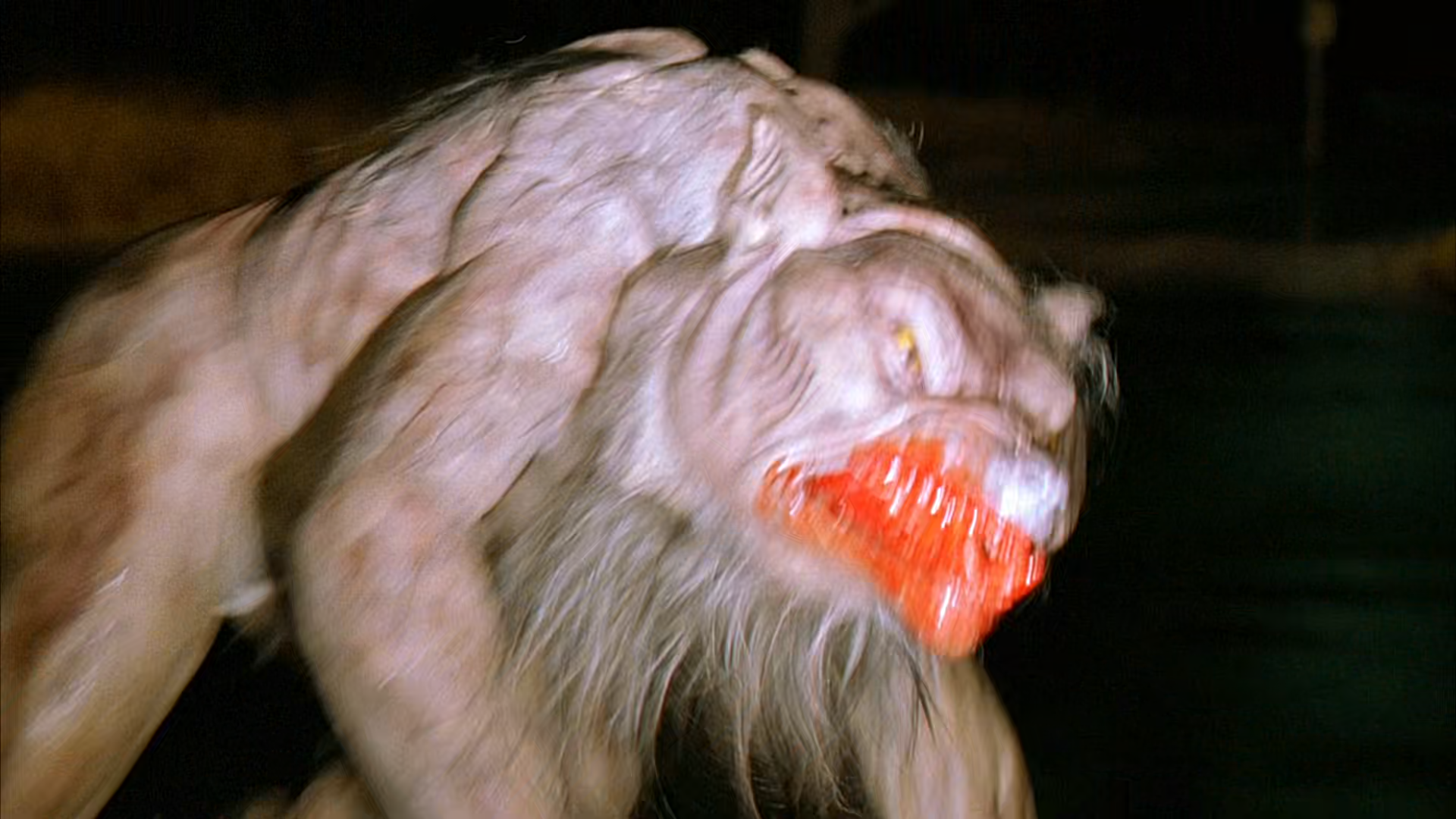
'We found that there is very little difference between a male and female dog, so when it comes to doing werewolves, they all look very masculine, (...) 'The one way to get away from that was to look not at a dog's body, but a cat's. Not a domestic cat, but a lynx or leopard or cougar - something that has a litheness, but is also extremely deadly when it wants to be. Obviously the head is very lupine, very wolfish, but it still has a lot of feline qualities.'


The Gingerwolf presented a few problems for Jones' team, '(Fawcett) was very specific about what he wanted, 'I want a werewolf with no fur!' That's new, it's tough to do as well, it was a four legged werewolf and it had a very long skinny body. So I immediately thought of doing a puppet but they nixed it right away, cos it just wasn't practical the way they were gonna shoot it'
'So they brought in a stunt guy, and he ended up doing a good job, but I always try to stay away from stunt guys in suit cos they tend to not act, they just smash through things, there's no nuance in their performance but the guy we got did a pretty good job'.


Jones further elaborated on the Gingerwolf woes, 'The biggest problem with the suit for me, from a technical point of view, was that it had no fur! Whenever you think of werewolves, you think, they're covered in fur, so you can hide zips and snaps and connectors and all the stuff you need to put a suit on, its never one piece'.
'So we ended up making the Ginger suit as two pieces, it was an entire full-body with legs attached and a separate head that would snap on. The only reason the Ginger suit actually has hair is because I glued it on and didn't tell John! (...) John, I need some hair, we have zips on it that I have to hide, and we can't glue it in cos (the stuntman inside) is gonna suffocate!'
Thankfully, Jones' compromise worked with Fawcett's aims, 'John also wanted it very feverish and very sickly looking, so we just covered it in a lot of sweat and goo and as soon as you wet down all the hair it goes very slick against the body (hiding the seams) anyway'.


So it ended up being a lot of sound effects and things like that. (...) But also when you cover something in slime, that helps a lot. You can bounce light off it, and we kinda obscured it with objects in the basement. It was a tough thing to shoot!'
While the stuntman in the suit could walk in it, running or leaping was out of the question, so a wire rig was attached to the suit to lift the performer to 'leap' on to tables.Jones remembered that Fawcett was enamoured with the werewolf suit to the point he loved getting it on camera. Jones explained;
'John loved the suit so when we got to set, he shot the shit out of it. I kept going over to him, 'John, you're not gonna use half this (footage)' and he was like 'Nah, it looks great!' so he just kept shooting and shooting it!And when they got to the editing process, I said to him, 'So how much of the suit stayed in the movie?' and he went 'Not much. Just what I needed but you were right, you can't over-shoot monster suits.'




Sources:
- Fangoria #202 'Grrrrrl Power' by Michael Rowe
- Fangoria #209 'The Sugar & Spice of Ginger Snaps' by Michael Rowe
- 2001 Sci-Fi-Online interview with Katherine Isabelle
- Assorted bluray special features.

No comments:
Post a Comment