Showing posts with label 1988. Show all posts

Wednesday, May 10, 2023

Fright Night Part 2 (1988)

The bulk of Fright Night Part 2's special effects were handled by Bart Mixon's Make-up FX Unlimited, the creature effects department of Gene Warren Jr.'s Fantasy II Film Effects. Mixon was delighted at the opportunity to work on the film; 'I turned to a page (of the script) and then it said 'Regine suddenly turns into a monster from hell', (...) I thought to myself, 'A monster from hell? This is going to be fun'.

The film's makeup effects workload was so big that Mixon had to assemble a large team consisting of temporary freelancers; 'At one point, a lot of people were available (...) But by the time I found out we would be doing prosthetics too, many of the people I wanted were working elsewhere. I started with a core group and was able to get other people for short periods of time.'

Mixon's core team were Brian Wade as key sculptor, Aaron Sims as key painter, Jim McLoughlin as key modelmaker, and Norman Cabrera. The freelancers were Gabe Bartalos, Barney Burman, Brent Baker, Matt Rose, Bill Sturgeon, Joey Orosco, Gregor Punchatz and Richard Snell.

Bartalos recounted how Mixon managed to keep such a large team from stepping on each others toes; '(...) Bart took advantage of everybordy's artistic abilities. Everybody on the crew was given one specific effect that was their own and then offered the oppurtunity to float and help out in other areas. Everybody knew what everybody was good at, so we didn't have to waste time feeling each other out.'

During production, director Tommy Lee Wallace kept an eye on the effects, as Mixon remembered; 'To a certain extent, it wasn't surprising (...) This was my first time keying a major effects film, and he probably felt he had to keep an extra eye on me. Tommy also didn't want this to be an all-out effects movie, which was part of the reason why he constantly suggested changes. None of that bothered me. It was his movie, and I was more than willing to give him what he wanted to make him happy.'

Similar to Chris Sarandon's Jerry in the first Fright Night, Julue Carmen's vampiress Regine would also undergo various transformations by way of special makeup effects. The first consisted of a facial appliance glimpsed briefly in the film, where Regine's face would adopt a more guant, chiselled appearance. Surprisingly, this makeup was difficult to realize according to Mixon;

Tommy Lee Wallace wasn't sure what he wanted (...) He kept saying 'Max Headroom' and I kept saying, 'What's that mean?'. As to how the makeup was designed, Brian Wade recounted; 'We came up with three appliance pieces, a lowered brow with an overlapping nose piece, a U-shaped cheek piece and a jaw piece that fit under the cheek and went from temple to temple.'

When it came to realizing Regine's 'monster from hell' guise, once more Wallace stepped in to alter the design according to Wade, 'Our initial reaction was to go with something wild with yard-long ears and spines coming out of the arms. (...) The teeth were going to be really monstrous. But the director's input, and the fact that the creature had to bear some resemblance to the finished giant bat puppet, resulted in reduction of the ears and teeth. What we came up with is good, but we could have come up with something totally wild.'
The final version of the monster Regine suit was sculpted by Bill Sturgeon, with Norman Cabrera sculpting the feet. The suit's hand appliances were fitted with finger extensions, with a prosthetic tongue and jaws also attached to the mask. Gabe Bartalos said, 'I also painted the nails and punched in the hair (...) It was an easygoing situation. Everybody worked on different things and had a lot of fun.'
Regine transforms fully into a bat creature form similar to the one Jerry adopted in the first film; two puppets were constructed, the first being a stopmotion miniature sculpted by Brian Wade, and built over an armature fabricated by Mike Joyce. The stopmotion sequences were shot at Fantasy II, and animated by Justin Kohn.
The original intention was to have just the stopmotion miniature bat, but Mixon recalled how this changed, 'Originally, the sequence was designed with only the stop-motion puppet in mind (...) Little by little, it evolved into a giant wing tip and then a full-sized bat seen crashing through the floor'.

The full-size bat puppet was molded by Jim McLoughlin and Brent Baker, and sculpted by Matt Rose, Brian Wade and Aaron Sims. The shot was achieved via the puppet being placed on a rod and pushed towards the camera.

Regine's death, where she is exposed to sunlight and her skin burns off, also was a heavy part of Mixon's workload. The first stage of Regine's death, were her skin bubbles as it is exposed to sunlight, was achieved via various puppet heads. McLoughlin described the process;

'We made a series of dummy heads, (...) The first dummy head had mechanics, jaw movement, fangs growing and brow movement, which I built into it. A series of tubes were also attached, which allowed us to pump trichloroethane to swell the head's latex skin. Gelatin burn makeup was applied to a double's hands to help bring the scene to life.'

The lifecasting process used for the dummy head (and earlier facial prosthetic was not an enjoyable experience for Julie Carmen; 'The six hours required to required to get the neck and face piece on was hard enough, but the actual molding of the mask was a killer (...) When the plaster began to harden, I got totally claustrophobic and started to panic. The only thing that saved me was that I meditated and gave myself up to the weight of the plaster. But I was so freaked that I went home that night and cried'.

'A few minutes after I stopped crying, the phone rang (...) 'There was a problem with the mold, and they wanted to know if I could come in early the next morning to do it again'. When recounting her experiences to Fangoria, Carmen jokingly stated she would add a clause to her contracts against ever having latex applied to her body again.

The puppet head mechanics were reused for the second stage of the melting sequence, where a burnt corpse prosthetic appliance was placed over the mechanics, with a gelatin 'skin' appliance also placed over it. When the puppet was set on fire, the gelatin appliance would melt on camera, exposing the skeletal prosthetic underneath.
The second-stage Regine dummy - minus the gelatin skin!
The second stage Regine dummy's gelatin skin.

A full prosthetic bodysuit was made for Regine's final moments, utilizing the same sculpt for the head as the second-stage dummy prop. The prosthetic suit was worn by Dinah Cancer in Julie Carmen's place, and took three hours to apply. The prosthetics were sculpted by Mixon, McLoughlin, Sims and Punchatz, and had torches applied on various regions to make it appear more burnt.

The melted Regine head sculpt.

Aaron Sims said of the melted suit, 'We tried for a droopy, melty look when we were sculpting the corpse body (...) At one point we even showed a nipple melting away, but for whatever reason, that shot did not make the final edit'.

Mixon's team handled the rest of the film's other vampire-related effects, such as the melting dummy effect of Russell Clark's Belle and the burnt makeups and dummy head (out of which water would gush from its throat) of Merrit Butrick's Richie, after he is splashed with holy water. Cabrera said of the prosthetic's design;

'We decided to go for a more puffy swollen look, kind of like what Dick Smith did in Spasms (1983), (...) Facial appliances were creatred to reflect what the head would look like after tubes were attached, and trichloroethane was pumped through the foam latex appliances, which resulted in that swollen bloated look'.

Mixon said of his team's work on the film; 'We've done a couple of things on this film that haven't been done before, especially with our approach to the Ritche effects (...) To a large extent, however, what we've done is traditional. It's primarily a lot of dummy heads and appliances, stuff that's been done before. We knew going in what would work, given the time and money we had, and we went with those things.'
Fantasy II was stretched thin with all the vampire effects, yet more makeup effects were needed for Jon Gries' werewolf Louie and the bug-spilling death of Brian Thompson's Bozworth. The Louie and Bozworth effects fell to Greg Cannom and his Cannom Creations crew, consisting of John Vulich, Larry Odien, Earl Ellis, Keith Edmier, Matt Falls, Loren Gitthens, Janice Barnes, Mitch Devane and Linda Notaro.

Gries would have a 'wolfman' hairsuit with facial prosthetics in most of his scenes as a lycanthrope; though in some scenes only the facial prosthetics were worn with a different, skin-coloured paintjob. The facial prosthetics resemble the first-stage transformation prosthetics that Cannom designed for the 1987 Werewolf series.

Cannom wanted to have Louis undergo a werewolf transformation sequence echoing Evil Ed's from the first film, but this was cut at the last second; 'The scene started with a real wolf, but because the real wolf looked so cute, they cut it completely out along with the transformation that follows. It's too bad, because there was a great shot that went from a paw stretching out to a human hand with a great wolf-bat look'.

The 'wolf-bat' facial prosthetics are only briefly glimpsed in the final film, realized as a latex mask. The dummy head was created, cast from the same moulds as the prosthetic, for when Louis has roses ignite in his mouth, as it would be too unsafe to light flames inside the actor's mask!

Cannom was fairly pleased with the finalized Louis werewolf with some caveats; 'The suit could have been trimmed more, and the face was a little too dark for my taste, but that's what happens when you get the suit back from overseas (...) at noon and it has to be on the set at 5:00. (...) From what I've seen, it looks pretty good'. Less pleasing was how his Fright Night Part II werewolf transformation was cut out so soon after Werewolf's cancellation, just as he was about to realize an ambitious transformation sequence for the show.

'I had a great werewolf transformation sequence planned for the new season (of Werewolf). It was a full-body werewolf transformation with no cuts. Eric's face and back would would stretch completely out and his body would have filled out from his face all the way down his back. As far as I know, nothing like that had ever been attempted before. Hopefully I'll find another project to use it in one day. (...) I'm fed up with werewolves'.

Sources:
  • Fangoria #76 (August 1988), 'A Hard Day's Fright Night' by Marc Shapiro.
  • Fangoria #77 (September 1988), 'Fright Night Part 2 Bares Its Fangs' by Marc Shapiro
  • Fangoria #78 (October 1988), 'Monster Invasion' compiled by Anthony Timpone

Sunday, April 16, 2023

Hell Comes to Frogtown (1988)

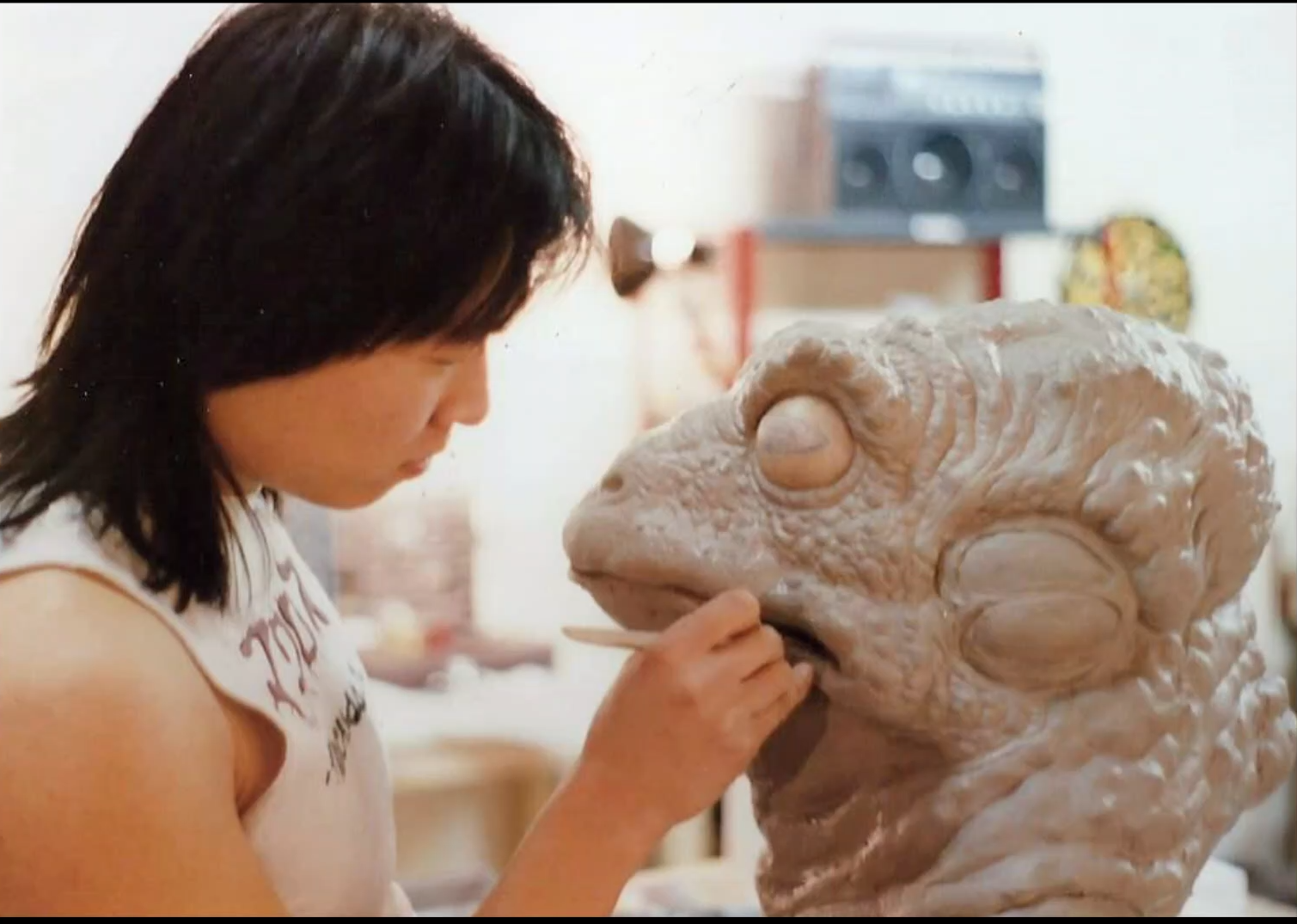
Hell Comes to Frogtown special makeup effects were designed by Steve Wang, who was asked to work on the film by Frogtown's director Donald G. Jackson as he was a friend of his; Wang agreed despite the low budget. Working alongside Wang in the 'Creature Effects Unit' were Matt Rose, Ed Yang, Grant Arndt, Steve Patino, Johnnie Saiko and Makio Kida, with Dave Kindlon credited as 'creature animatronics'.

Wang's love for Japanese 'tokusatsu' productions actually did play a role in his work for Frogtown, as when approaching how to realize the mutant frog people on a low budget, he remembered an episode of Spectreman that involved frog people. To get around the budget constraints, only one fully animatronic frog head would be made, for the tyrannical Toty. The Toty head's animatronics allowed the eyes, lips and ears to twitch about.

Steve Wang with the Toty animatronic head behind him.

One detail that was cut was that Toty would have four arms, which meant a rudimentary bodysuit was made, with only the hands having prosthetic skin on it; in the final film Toty always just uses two hands.

The low budget meant that it wasn't enough to have the other frog heads be full animatronics; thus for the other frogs of 'Leroy' and 'Bull', more simple puppet heads were created, which could have the mouth move from the actor's own mouth movements via a simple cable mechanism, and air bladders were fitted in order to simulate the ears and throat bulding. There wasn't enough money to come up with how to make the eyes move, so they got around it in the easiest way possible; they had the eyes covered with eyepatches and goggles!

Steve Wang with one of the non-animatronic frog masks.

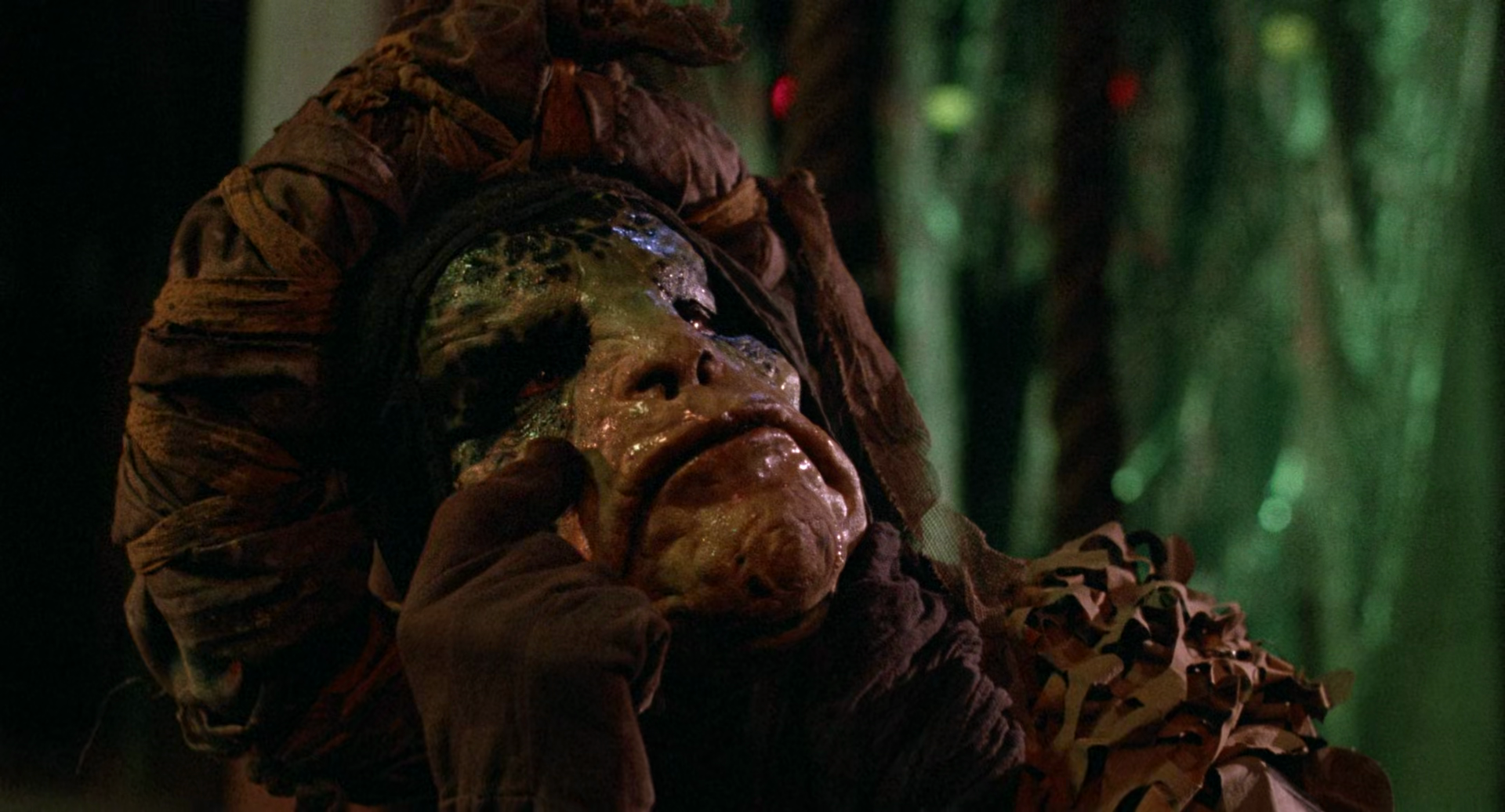
The film's budget was not high enough for all the frogs to be realized as puppet heads; and so instead prosthetic makeups were designed, these frogs looking more humanoid than Bull or Leroy. These makeups were worn by the various extras playing Frogtown's guards, and thanks to them wearing hooded garments, meant the seams would be easily hidden.

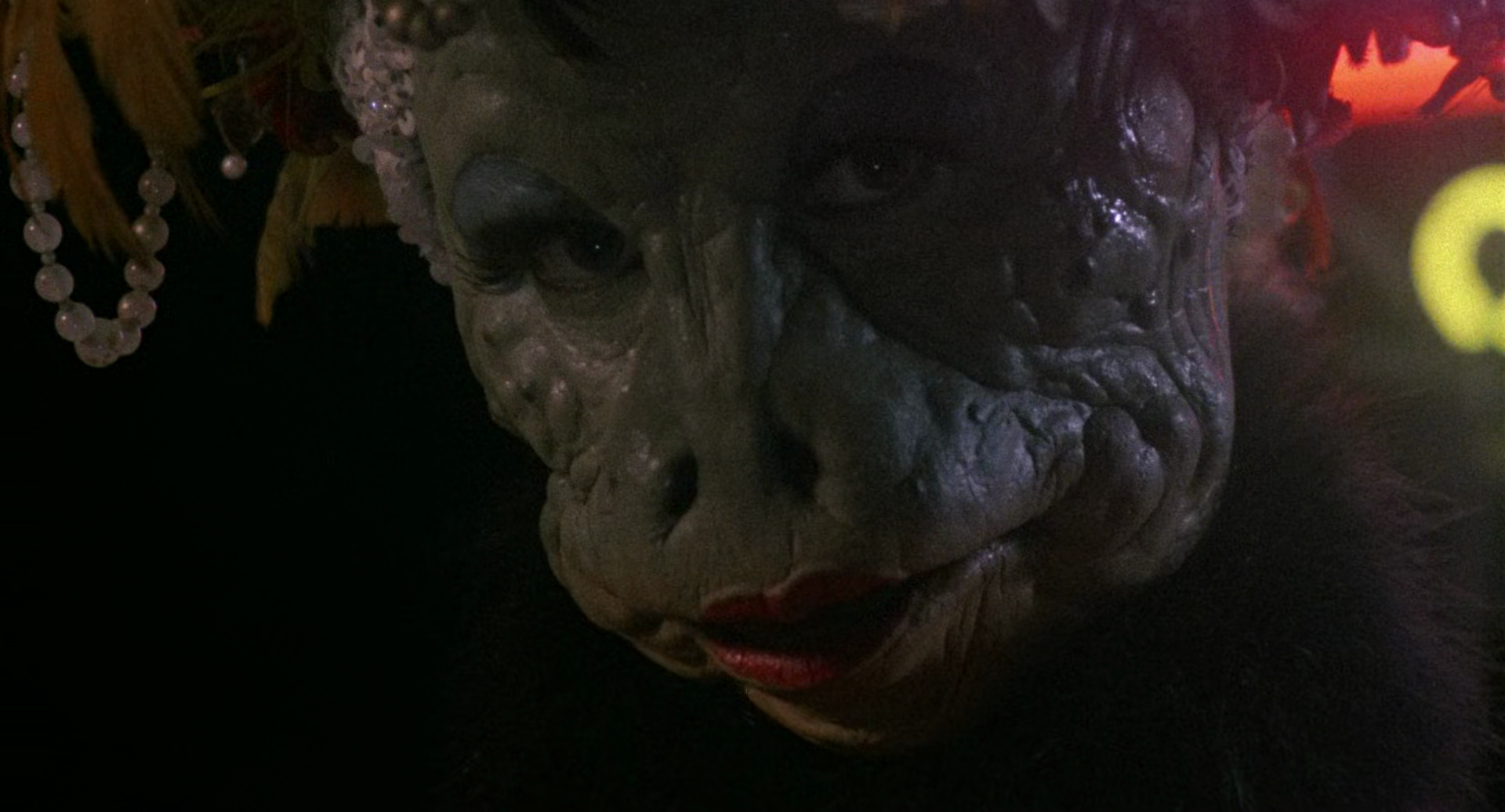
However, a different prosthetic would be made for Kristi Somers to wear as the frog prostitute Arabella; her prosthetics would be slightly more human-like and feminine, especially with large, protruding lips. Again, like the various guards, the costume would do the work of hiding the prosthetics' limitations.

In the 'Creature Feature Creator' behind the scenes documentary included in Hell Comes to Frogtown's bluray release, Wang said as much that he was mostly glad with the reviews praising the special effects, regardless of whether they liked the final film or not. Donald G. Jackson would make a good few sequels, but given his films tended to be genuinely zero-budget affairs, I'm not sure if these even had any special effects put into them; Steve Wang certainly didn't return to the series!

Sources:

- Creature Feature Creator: Steve Wang Reveals the Secrets Behind Hell Comes to Frogtown's Mutant Manifestations (2014)