(Note: I would like to thank Ed French for sending me some of the images included here via email, as well as hosting them on his own Instagram page!)
Note as of October 2026: I would like to thank Tyler K. Smith for having sent many images of his work on Tales from the Darkside (and many other productions! Which I will get round to eventually!). Smith's fantastic artwork can be seen on his website Bombotz.com
'Trick or Treat'
Ed French handled the makeup effects for the show's pilot episode, where a nasty old miser gets a supernatural comeuppance one Halloween's night. The first of these tormenters, a classic gnarled witch, was a prosthetic applied on Frances Chaney.
Another ghost, the undead pirate, was realized as a facial appliance on Billy McNulty.
The miser eventually ends up in Hell, where he is greeted by the Devil; Ed French recalled how, alongside the other makeups the devil prosthetic proved to be a last minute problem.
"I had three weeks to create three full-face prosthetic makeups, the archetypical witch, devil and pirate, theatrical dentures for these characters, three demon masks, and some weird hands (actually slipover gloves). In addition to working within this relatively short schedule, the actor playing the devil dropped out of the production after I had completed his facial appliances and teeth.
Since I had life-casts of myself on hand, I became his replacement and ended up completely resculpting, casting and baking the new devil appliances in 48 hours. I'm sure it's not the world's record, but that was about half the time that I initially alotted myself when I created the first devil makeup.
Fortunately I had learned that it is essential to budget a bit of time into my work schedule for one or two setbacks to any original plan. Call it a blueprint, if you wish, It's your strategy for bringing in your makeup effects on time. The scary thing is that when you're inexperienced you're not exactly sure if this little battle plan takes everything into account."
The three demons flanking the devil were simple pullover masks, but sadly obscured in the actual episode. One of these masks was shown more clearly in Fangoria #33.
'I'll Give You a Million'
The makeup effects for this episode, which was shot in Los Angeles rather than New York, was handled by Bryan Moore. Moore handled the makeups on all the episodes shot in LA.
Originally, Moore just had to handle the makeup on George Petrie, after his character has returned from the grave. Moore explained in Fangoria;
"I made these rubber appliances since I didn't have time to use foam. The actor, George Petrie, wouldn't let me cast his face. So, I did a face cast on myself, sculptued two wrinkled cheekbone and eyebrow appliances, and put those on his face. Then, I glued on tissue paper and Dueo surgical adhesive on his face, so that it looked like rotting skin falling off it."
Moore had to make another last-second prosthetic, for the grimly humorous closing shot after Keenan Wynne's millionaire has sold his soul. Moore explained further;
"Towards the end they asked me to make Wynn's chest look like it had a big brand on it. I said I could do it, but I really didn't know how. After racking my brains, (director) John Harrison and I went over the Wynne's house, and he laid on the kitchen floor so we could cast his chest. It was kind of wild because he fell asleep. Wynn's wife came up and yelled, 'Keenan, are you OK?' I took the cast home and sculpted an appliance. (...) There's a bladder underneath and tubing, so if you blew cigarette smoke through the tubing, it came out through the letters."
'Inside the Closet'
Tales from the Darkside was produced by George A. Romero, and so it was natural that he would eventually offer some episodes to his longtime collaborator Tom Savini. In addition to handling the makeup effects, Savini also would direct this episode.
Savini recalled in Grande Illusions Book II, "This is the first thing I ever directed and I wanted the creature to be something special. I had never done a full size mechanical creature before. There wasn't a lot of time and hardly any money, and that was the challenge.
Over a wire armature, I sculpted Lizzy in Roma clay in two weeks. I laid her on her back on a pipe stand and hot glued blocksof wood together to a height that would be about halfway into her torso. The blocks served as a base on which I could lay water clay to form a separating wall to pour plaster on to create the front half of her upper torso mold.
I remember waking my wife up at three in the morning to come downstairs and help me turn Lizzy over to do the back half. Once I had the upper torso molded, I cut off her arms, to be molded separately, and molded her lower body overlapping the area of her midsection covered by the upper torso mold. From a core made from the upper torso, a fibreglass chest and head was made for the foam latex Lizzy to fit over. This was the same technique used for making a fibreglass underskull for a mechanical mask like 'Fluffy' in Creepshow".
Savini continued,
"While I created the shot list, Dave Kindlon mechanized Lizzie's face and hands, and Pat Tantalo ran the foam latex. I created her teeth and painted her.
She runs around nude, so I have her a hanging sort of belly to disguise her sex. She was basically a rod puppet with rods that could bend around the actors, moving her arms. Me, Greg Nicotero, Dave Kindlon, and the Lauditi brothers, Anthony and Joe, were the puppeteers."
'A Case of the Stubborns'
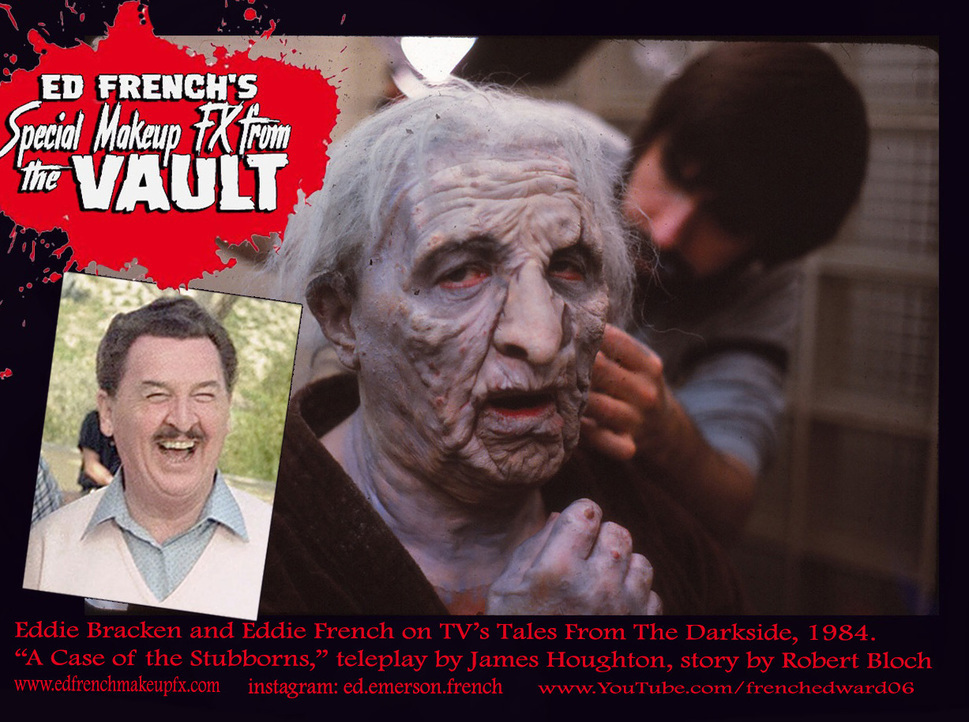
Ed French contributed this episode's makeups, which went to showing the gradual decomposition of Eddie Bracken's undead grandfather.
'The Impressionist'
Bryan Moore handled the episode's creature effects, which mostly went to handling the alien Hoffgosh. Moore originally had a very different look planned for the alien!
'I wanted him to look like the Tasmanian Devil from Looney Tunes, and I sent my designs to Armand (Mastroianni). He liked the designs, but he wanted a peaceful, asexual alien. He and the art director made a design and I sculpted from it.'
'Originally, I was supposed to make a full body suit, but the way the budget was, all I could make was a head-and-shoulders mask, the hands, and some dentures. They girl they hired to play the monster is a professional mime. The face didn't move too much, but she really made it come alive.'
'Halloween Candy'
The episode's premise echoed the pilot episode, in that yet again it was about a horrid old git getting his just desserts from Halloween spirits. Tom Savini directed the episode, and yet again handled the creature effects. Savini explained in Grande Illusions;
"If Christmas has Santa Claus, and Easter has the Easter Bunny, then Halloween has "Butch". That's the premise of the story I directed, and once again no time and little money to create 'Butch' and the effects in the story. I decided to bastardize the underskull of a demon I made for (1982's Till Death Do We Scare). We tore the demon skin off and covered the underskull with plastic wrap and made an alginate negative mold of it, which produced a plaster positive on which Howard Berger sculpted an entirely mew creature...'Butch'."
"Howard also played Butch in the close-ups, wearing the special lenses that were made for the (Till Death Do We Scare) demon. He also sculpted the finger extensions. Greg Nicotero did the hand appliances for John Edward Allen, the little person who played Butch in the wide shots. The demon underskull was already fully mechanized. The facial movements fit the face of Butch because he was sculpted over a cast of the underskull and its mechanisms."
Meanwhile Ed French handled the death of the aforementioned horrid old git, creating a dummy gelatin head in Roy Poole's likeness.
'The Satanic Piano'
Bryan Moore handled the makeup effects, which mostly went to a gruesome burning makeup showing even the bones underneath. Moore explained,
"On 'The Satanic Piano', we got away with showing bones and blood when Michael Warre beats on the piano with his hands. His hand comes out looking like a really gross piece of barbecued chicken. Originally, both hands were going to be mangled, burned stumps, but that would have been pushing it."
'The Devil's Advocate'
Ed French handled Jerry Stiller's slow transformation into a demon, which was entirely realized via a combination of makeups and editing. French explained at length to Fangoria;
"On 'The Devil's Advocate', we had foam appliances, hair pieces,dentures, rubber prosthetics and hands. (...) For the first couple of changes, you're not supposed to notice what's different about him. It's subliminal, and Michal Gornick edited it so that the changes sneak up on you.
I got the script for 'The Devil's Advocate' about two months before they shot it, and I was hoping to hae a month to work on it but time dwindled down to about two weeks. It became another marathon number getting it together But the script was so clear and well-written, that it spoke for itself. The character is generating into a monstrous, demonic creature. I wanted Stiller to look like a real-life Bowery bum degenerate, to give it an interesting reality.
There are some interesting physical changes as well. The last transformation involved five different makeups. Even his hands begin to mutate, and I gave them an arthritic bone diseased look. Stiller was very much a demon in that last scene."
'Monsters in My Room'
The makeup effects for this episode, about a boy menaced by imaginary monsters, were handled by Tyler K. Smith, a makeup artist and sculptor based in New York City. Smith fabricated two makeups; a witch and an ogre.
The ogre makeup consisted of sculpted appliances and dentures, applied on George Kyle who was credited as the 'Boogie Man'.
The witch makeup also consisted of appliances and dentures, and was applied on Leona Cyphers, credited as 'Horrible Witch'.
'The Last Car'
Bryan Moore handled the makeup effects, which went to realizing the undead passengers of a train bound for Hell. Moore explained to Fangoria at the time,
"Mrs Crane (the old lady corpse) was the favorite thing I got to do this year. She's like a gross Muppet. The working parts are two mechanical hands, which are arm extensions that take two people to operate.
There's a head-and-shoulders puppet, but with no mechanics in the head. It's a rubber puppet, with polyurethane foam in certain places to hold its shape. It took three people to operate Mrs. Crane from a hole in the back of the seat.
There are three corpses that I sculpted for 'The Last Car': Mrs. Crane, a conductor corpse, and a little kid. At the last minute (producer) Jerry Golod wanted to change the ending and have the girl turn into a corpse. So, all we could do was put a wig on the conductor corpse and dress him in her wardrobe!"
'The Circus'
Ed French had a heavy workload for this episode, as he had to realize several monster makeups and props. The first of 'The Circus' assorted makeups was a gnarled vampire.
The second makeup was a classic 'Wolf Man' werewolf, barely seen in the final episode.
French's other duties for the episode included a decapitated Frankenstein's Monster dummy head, and a puppeteered mummy head.
'Black Widows'
Bryan Moore made the prosthetic mask for a man shrivelled up into a husk.
'Seasons of Belief'
The 'Grither', a fairytale monster tormenting the hapless family of this episode, was realized by Tyler K. Smith. Only the Grither's arms were seen, so Smith made a pair of static prop arms that could be operated behind the set's walls.
'My Ghostwriter - The Vampire'
Bryan Moore made an air bladder appliance to be worn by Roy Dotrice as his vampire is exposed to sunlight, with the appliance coated in veins.
'The Grave Robber'
Mike Maddi handled this episode's makeups, which mostly went to the undead mummy. In most of his scenes, the mummy was covered up in bandages.
'The Cutty Black Sow'
Ed French handled the titular boar monster, with assistance from Ken Walker. The Sow itself was an articulated mask with lips able to curl, and the eyes lighting up; the look was completed with sculpted hoof-like gloves.
'Family Reunion'
This was the last episode Tom Savini directed for the show, and yet again he designed its makeup effects. The budget prevented more elaborate werewolf masks or suits being created, so Savini had to go for a more minimal approach as he explained in Grande Illusions: Book II.
"This was the last Darkside episode that I directed, and I had to transform a woman and her little boy into werewolves. Do I have to mention 'no time or money'?
Casts of Daniel Kelly and Patti Tallman were made by Mike Maddi and sent to me. I duplicated them and created stages in the makeups. I sculpted the upper and lower lip snouts, two for Daniel, and two for Patti, while Taso Stavrakis sculpted the various ear appliances.
The beginning stage snouts were just wolf noses and lower lip pieces. These were worn with fangs over their real teeth. The second stage sculptures included the teeth and longer snouts. They were just foam latx appliances but the teeth were painted and covered with five minute epoxy which made them look hard and shiny. I hired Mike Maddi to apply the prosthetics."
Savini also explained how editing also helped the makeups come to life, especially with the budget restrictions preventing any elaborate transformation effects!
"The actors had to stick their tongues out constantly to make these longer snouts look real. Patti's transformation took place, stage to stage, as she turns from one camera angle into another. I wanted Daniel's transformation to be interesting in the time we had to create it.
I thought of Werewolf of London and Henry Hull transforming as he walked behind pillars. So, I made Daniel transform as he walked towards us, in and out of shadows created by the moonlight through a nearby widow. He'd walk into shadows, we'd stop the camera, and Mike would apply more makeup. Then he'd walk out of the shadows in a new stage, etc..."
'Hush'
Tyler K. Smith, in addition to prosthetics, also had contributed special props to the series. For this episode, Smith fabricated the 'Noise Eater', a killer machine that sucks the life out of its victims. On the end of the hose was a sculpted piece resembling a lamprey's mouth.
Sources:
- Fangoria #33 'Professional Makeup: How to Get Started' by Ed French
- Fangoria #51 'The Makeup FX of Tales from the Darkside' by Anthony Timpone
- Grande Illusions: Book II (Tom Savini, 1996)