
It took only a year for Dino De Laurentiis to greenlight a film adaptation, which had its screenplay penned by King himself. De Laurentiis gave the job of designing and realizing the werewolf itself to Carlo Rambaldi, with Michael McCracken handling the other makeups.
Rambaldi's creature effects crew included Paolo Scipione, Steve Townsend, Ralph Cobos and William Cobb. Meanwhile McCracken's makeup effects team was Michael McCracken Jr., Matthew Mungle, Jill Rockow, Michael Stein, Chuck Stuart and Jeff Kennemore.McCracken's main task was the nightmare sequence where Everett McGill's reverend Lowe sees his entire congregation transform into a howling pack of werewolves. This was no mean feat, as the scene required twenty performers to be made up as werewolves.
The first stage church werewolf prosthetics utilized air bladders, to make it look as if each churchgoer was transforming on camera.


"The B team's faces can be operated with a tongue device. By moving the device inside the mask they can make the face snarl. The A team has radio operation providing three levels of movement in the face. They have ear, forehead and mouth movement. The C team functions mainly as background. Theres no movement in the mask itself for them. Their's is purely body movement."


Michael McCracken Jr, who worked with his father on the film, had an amusing (and rather saucy) memory of one of the werewolf performers. "That whole church scene lasted about a week, and every night after a shoot we had to take the actors out of makeup. Except for one individual. This one guy never wanted his makeup taken off, and we could never figure out why. So we finally found out on the last day. He said, 'So guys, I finally have to tell you. I love being a werewolf, because when (the crew) wrap, I go to the most amazing sex parties you can imagine. Women love me to show up as a werewolf.' Hey, more power to ya!"


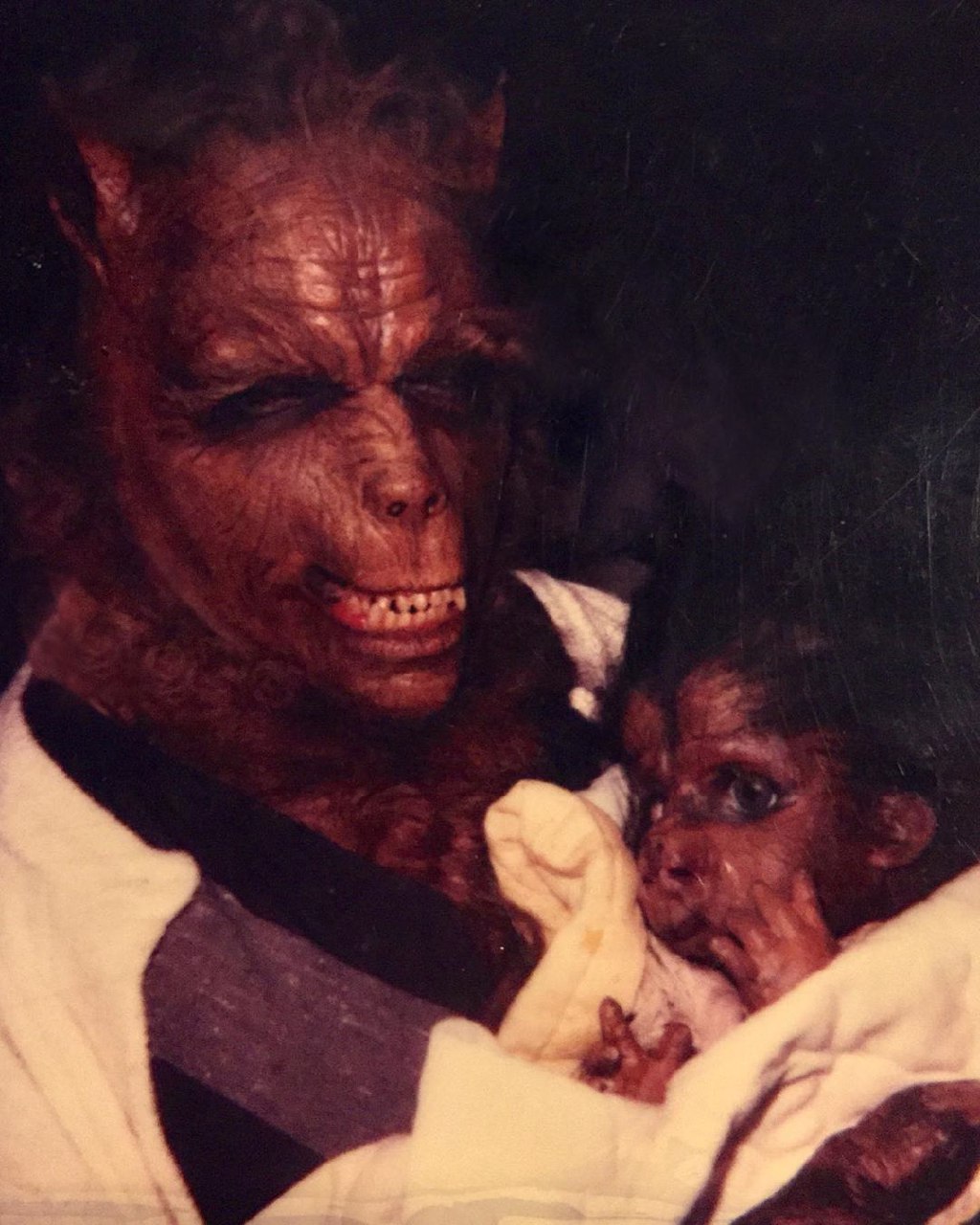


McCracken had several prosthetics sculpted to represent each stage of the transformation; the first (or final?) stages mimicked Everett McGill's own to represent his blinded face, while the final (or first?) stages were large masks mimicking Rambaldi's werewolf head.


"We thought about having the actor wear a mask of his real face over the makeup. That way he could go under the fog, pull the thing off, and then come up looking like his face has been ripped off. That's a bit risky though, and for take two it would really be a bitch."
Instead, McCracken opted to just use an elaborately sculpted dummy head, that would be lifted from under the fog before pulled down again, and also made a decapitated head prop for the drunkard slain by Lowe during the film's opening sequence.


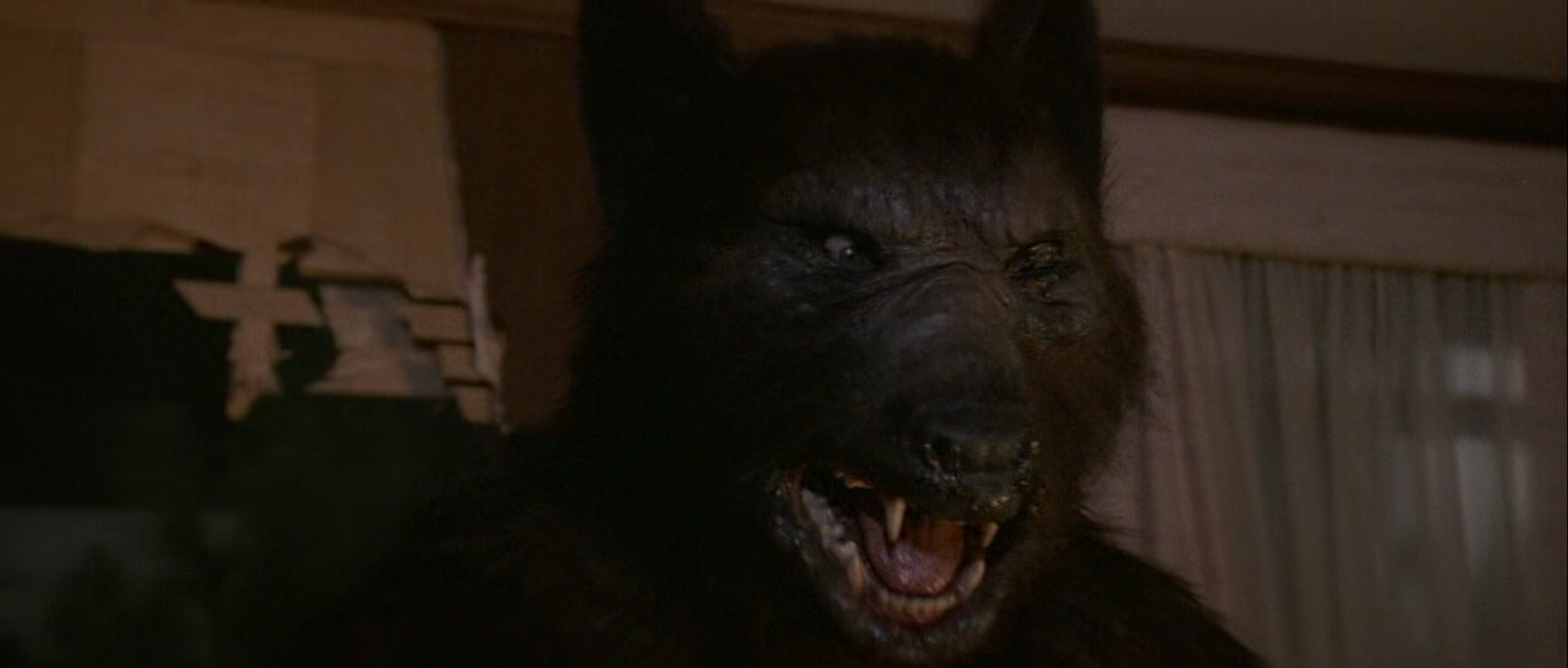
The werewolf form of reverend Lowe fell to Carlo Rambaldi. Rambaldi already had a working relationship with De Laurentiis, having contributed to the infamous 1976 King Kong, White Buffalo, Dune, and the same year's Cat's Eye (also a Stephen King project, no less).
Rambaldi's work on Silver Bullet was fraught with problems, much of them stemming from De Laurentiis himself. Rambaldi himself was anxious about the project, as he said in Fangoria.
"I started talking with Dino about (Silver Bullet) when we were in Mexico, working on Dune, but I wasn't given a start date. By the time I was told when it would start, it was already too late, too little time. No time to cast actors, to make molds. And, for business reasons, for additional help I can only call the union, and often the union does not have good people for this kind of work. All of this makes it very difficult, and casts some risk for my prestige."According to Rambaldi, it was actually De Laurentiis who didn't want to copy the novella's Bernie Wrightson werewolves, and instead wanted an original design. "Dino said to me, 'many films have had werewolves, now I want something different' and we talked about many possible things. Maybe they could be like something from outer space,or maybe they could more like a dog, or more like a human being than other movie werewolves. Now we're changing the werewolf, though while we're here we cannot make any changes in the internal mechanism. But we are making changes, and maybe will have the finished werewolf by tomorrow....it is so much better to start with a clear idea of what is wanted."
In the same Fangoria interview, Rambaldi didn't elaborate on why De Laurentiis rejected his original ape-like design. "Dino wanted it more human-like, not so much wolf. Now he wants it more like a wolf." However, Matthew Mungle remembered the on-set drama years later."So we got on the set, and we're just standing back. (...) It was Dino who coined the phrase, 'He looks like a werebear!' And so being Italians, they (Dino and Carlo) got into this huge fight, verbally abusing each other on the set in front of us. Carlo had to go back with Steve Townsend that night, cut into the (werewolf suit's) whole face and reconfigure the snout."


The suit took five weeks to build, with De Laurentiis' fickle demands not helping. Michael McCracken also remembered Dino's change of heart. "The theory on (Rambaldi's werewolf) was that Dino originally wanted a werewolf that was part werewolf and part something else, a werewolf but not exactly. Carlo went through numerous sketches to try and get in sync with what Dino had in mind, and the first werewolf was just that. Then Dino had a change of mind and Carlo did a second werewolf. They've finally settled on the one they have now."


The suit was padded to give the appearance of musculature, with the performer's head hidden in the sloping neck (a trick that was experimented with on The Howling, and successfully done on Bad Moon). The suit itself was worn by both McGill himself and a stunt performer.
McGill explained how he approached his role while inside the suit. "What do you emphasize, the canine or the human? It's tough. You try to find the right combination that will satisfy the requirements of the costume and makeup, as well as your interpretation of the role. You can choose to play the man in the animal or the animal in the man, But you have to choose. You can't play both. I prefer the idea of the man trapped in the animal. That's the more horrifying."


Rambaldi still wished to keep up an uncanny element in the final werewolf design. "The werewolf is a wolf. My creation is directed toward a real wolf, and you don't need to create anything more. (...) It's wolf with human inside; not exactly a wolf. A wolf doesn't have that movement. There is no (natural) need for a wolf to smile."
Rambaldi had another reason to keep a human element in the design; in the original Cycle of the Werewolf novella, the werewolf is entirely a creature of spite, taking sadistic glee in its killing. King furthered this in the first drafts of his Silver Bullet screenplay by having the werewolf talk, jeering and snarling insults at its prey.
This trait of the werewolf remained in the script long enough for Rambaldi to take it into consideration, and so the head was mechanized to lip-sync with the dialogue. Two werewolf heads were made, a stunt head and a mechanized head, the latter used for close-up shots.


The mechanized head's expressions were controlled by twelve levers, using pneumatics like a bicycle's brakes. The internal mechanisms, made of aluminium and steel, made the suit head very hard to wear as McGill remembered.
"Inside the head is a lot of servos, pivots, lot of wiring. Any time the creature would have an expression, a growl or a widening of the eyes, these servos and wires are just smashing into your face, because there's not enough room for it to work. That took some getting used to, that and the suit which is incredibly hot."



Sources:
- Cinefantastique Vol.15 No 5 (Jan 1986)
- Fangoria #43
- 'Full Moon Fever: The Effects of Silver Bullet'
- 'The Wolf Within' interview with Everett McGill
