Joe Dante's main concern when adapting Gary Brandner's
The Howling was how to realize the werewolves. In the novel, the werewolves' lupine form was just that of a real wolf, something that Dante was not keen on. Dante explained;
'It was one of these situations where what works well for a novel (...) isn't necessarily going to translate well to film. There had been a previous script which had thrown away the idea of werewolves and instead was about people's spirits going out into the woods and inhabiting real wolves. This meant that you were going to see real wolves, which gets you into The Wilderness Family territory. That's not particularly scary to me'.
Another issue was that by this time the werewolf genre was more or less moribund, with even fairly recent films such as 1973's The Boy Who Cried Werewolf still using similar makeups and transformation effects established on The Wolf Man decades earlier. Dante said;
'
The last couple of werewolf pictures had not been notable successes; Freddie Francis' Legend of the Werewolf did not even get distributed here, and after a couple of pictures like The Beast Must Die, it seemed like the whole genre was running out of steam. So if we were going to go ahead and do one of these movies, it seemed like it was important to try to do it differently.'
If The Howling was to make its mark on audiences, then it would be via the special effects, which were handled by Rob Bottin. Bottin earned the job thanks to his work on Dante's earlier Piranha. On that film, Bottin met producer Mike Finnell, who when producing Rock N Roll High School, called on Bottin to realize a giant mouse costume.
However, at this point, it was Rick Baker - Bottin's mentor - who was supposed to handle
Howling's makeup effects, but Baker had already promised to John Landis that he would do makeup effects on
American Werewolf in London. Even though that film had not yet been greenlit, Baker still wished to be free enough to work on it.
Finell, who had seeked out Baker, but was already familiar with Bottin who at that time was still Rick Baker's protege, decided on a compromise. Baker would be hired as long as Bottin was brought along with him. Should Baker be called off the project, then Bottin, who had already proven himself capable twice before, would handle it alone.
Just a day before Baker and Bottin were to sign their contract to work on
Howling,
American Werewolf in London was greenlit. John Landis did not react kindly when hearing that Baker was working on
Howling, leading to a vicious phone call in true Landis fashion. Baker, who had sculpted some initial designs for the werewolf, had to leave the project.
Baker recounted; 'As I started sculpting I could see it was taking on the look I wanted for American Werewolf. I told Finnell and Dante that it wouldn't be fair to John Landis to use that design so I couldn't design for them, but would remain available to solve problems and answer questions.'
Rick Baker working on a sculpt early in The Howling's production.
This design was never used in Howling at all, but doesn't it look a little similar to American Werewolf's lycanthrope?
Baker's abandoning of the project meant that the buck was passed to Bottin, who would still have some guidance from Baker but otherwise was now handling the project himself.
Bottin remembered how daunting the assignment was, partly for the massive workload; '
I just spent days wondering, 'How am I going to pull this off?' (...) The list of effects they wanted was amazing. They wanted the most incredible transformations ever filmed. And they kept asking me 'Are you sure you can really do all this stuff?'
Bottin assembled a large crew that at points numbered 25 people, a feat given how low
Howling's production budget was. Most notable among Bottin's team was Greg Cannom, who sculpted and applied the bulk of the film's prosthetic makeups.
Some of Cannom's more subtle makeups included brow and forehead applications on Christopher Stone, Don McLeod, and Elisabeth Brooks, for the earliest stages of their transformations. Fake fangs, applied fur and nail extensions completed the look.
The various makeups were complimented with 'wolf eye' contact lenses made by Morton Greenspoon. McLeod recalled an uncomfortable incident involving the contacts;
'The lenses were painted by hand (...) but unfortunately, it wasn't Rob's fault, but one of the crew painted the lenses and used acrylic paint, like you'd use to paint a model airplane or something, and they didn't realize that would be a really bad thing to put in human eyes!
So they stuck these lenses on me, and I had them on for five minutes, and my eyes just started burning. They went ahead and filmed the scene, and I had lost my vision for hours afterwards. I couldn't drive my car home, a crewmember drove me home and I was just cursing and rubbing my eyes with ice packs. I went to the doctor the next day and they said I was lucky I didn't get permanently blinded.'
Several latex face masks and prosthetics were made for the barn fire during the film's final act. The more wolf-like latex face mask later was
reused in an episode of The X-Files over a decade later, loaned by Greg Cannom to Toby Lindala's Vancouver crew.
The first major challenge were the transformations. Bottin and Dante were firm in that they were not going to do mere cutaways or time lapses. Bottin was given free reign, to the point that even the script was written to allow his imagination do all the work;
'When it came to the wolf scenes, or anything having to do with special effects, Joe had told the scriptwriter, 'Look, we don't know what this guy's going to come up with'. Joe figured, why writer something into the script that we may not be able to do for the budget. So when the script comes to a transformation scene, it only reads '...and then he changed into a wolf.' Nothing about pointy ears, the spine snapping, or the chest bursting. That was left pretty much to me, and it was great to be trusted to that extent.'
However, the prospect to realize a transformation sequence that had never been seen on film before proved to be daunting for Bottin; '
We were stumped for a long time. I talked to Randy Cook, Jon Berg and Phil Tippett about the possibility of using replacement animation, but that didn't go anywhere. At that point, Rick and I were just going to do the transformations in cuts.'
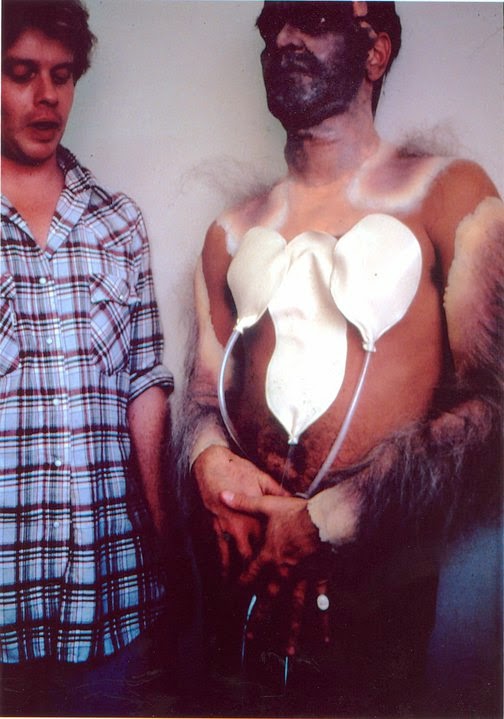
Bottin found inspiration from Dick Smith's work on
Altered States the year before, which had utilized air bladders for the transformations. Bottin came up a prosthetic appliance fitted with air bladders under the latex 'skin', conveying the idea that the flesh was reshaping itself.
Robert Picardo, playing the lycanthrope Eddie Quist, had air bladder prosthetics applied on his chest, arms, neck and face. The 'air bladders' under the face prosthetic were condoms, while the air bladders under the throat and chest appliances were hot water bottles. The throat appliance proved to be dangerous, as Picardo was not be able to breathe when they inflated.
Fur was also added on Picardo's arms by Greg Cannom, who applied all of Picardo's makeups. Picardo's facial prosthetic was sculpted to have a 'brutish' appearance.
A gruesome makeup, also with air bladders underneath the forehead and throat appliances, was designed for Picardo to wear as Quist after having been disfigured by acid. Picardo was unhappy wearing the gorey makeup, which led to an amusing incident;
'One day, being very glum, when it was the big makeup day, the acid face where they burned half my face off. I'm sitting in the hallway, after my 6 hour makeup session, looking very despondent. Like gosh, trained at Yale, two leading roles on Broadway, my first movie in California and my face is melted off in a low budget movie. And I'm sitting there with that look on my face, and Denis Dugan comes up to me and says 'Bob, next time, read the whole script'.
An extra air bladder prosthetic facial appliance was made for Elisabeth Brooks to wear during the barn fire sequence; it is only seen briefly.
While air bladders were used for the early stages of Quist's transformation, the rest would be achieved by puppetry - a method that Baker also had planned for
American Werewolf, and which he would eventually realize the same year
Howling was released.
Several puppet heads and werewolf masks were created by Bottin's team, utilizing similar techniques Baker and Bottin had used for the ape mask in
Tanya's Island.
The transforming 'change o head' puppets had internal mechanics of gears and level assemblies, as well as a device invented by The Burman Studio specialized for facial movements.
The mechanisms of the change-o-heads were designed to reshape the puppet's skull, via a cable controlled mechanisms. Doug Beswick provided assistance on getting the mechanical 'change o heads' to work. At least three 'change o heads' were made to represent Eddie Quist's transformation. Bottin explained the design process;
'What I did was put Bob Picardo through an all-day casting session, making 5 full-head casts - a terrible experience for him - and made all these face studies. Rather than making the wolf *on* Bob's face, I made it *from* his face. That may sound like about the same thing, but I was taking Bob's features and distorting them, making them animalistic. I looked for characteristics in his face that could be frightening to me, and exaggerated them. I think we came up with a very weird look.'
The first stage Quist change-o-head puppet
'I thought, well, maybe his nose go UP first, looking something like a pig's, and then grow out from there. Then, I thought, what sould the next step be? I had to guess. And I really wanted everything to be fresh. I'd do sculptures and then show them to my friends. If they reminded anyone of Island of Dr Moreau or Planet of the Apes, I'd start over.
The change-o-head puppets had a problem; other than their intended function, they were static. This fell to director of photography John Hora to solve;
'One of the things we would do was always make sure the camera was moving. What we did when we filmed it was change the speeds during the shot. The shot might start at 24 frames per second, which is normal speed, and as the action is progressing we would drop to 12 frames, and speed it way up so it had an uncanny fastness about it. Or as it drooled, we might go at a high speed, and slow it down so the saliva would drool slower'.
The second stage Quist change-o-head puppet
The transformation had been intended to be smooth and fluid, but technical limitations gave the on-screen transformation a jerky, shuddering look. Dante recalled; '
When we came to do it on the set, we would press buttons, or pull things, and sometimes things would pop. We tended to view it as a mistake, and when we were editing the scenes we tried to cut around the parts that changed abruptly.'
The scene was saved in post-production sound editing, as crunching and cracking sounds were played over the footage; '
All of a sudden they looked like they were on purpose. So the whole concept, instead of being this sort of supernatural, smooth, gliding change, became this torturous, painful, bone-cracking metamorphosis. In addition to covering up our mistakes, it improved the whole scene.'
The third stage Quist change-o-head puppet
A puppet 'chang-o-hand' was also made for the shot when Eddie Quist raises his hand (during the air bladder stage of the transformation), showing claws bursting out the end of it.
The change-o-hands with an early werewolf head sculpt.
Another change-o-head was used to depict Don McLeod's transformation as TC Quist in a very brief shot. I have seen it shared online that this was a preliminary transformation test puppet made by Baker and Bottin to convince Avco's executives that they were able to supply the effects on a budget. But, I so far haven't came across a concrete source, so this could have been made later in production for all I know.
During the barn fire scene, a puppet head - it does not appear to be a prosthetic makeup - is also briefly seen, and seems to take on a different shape in the snout in different shots, indicating that it was also a 'change-o-head'.
Was *this* one of the makeup tests that Baker and Bottin had brought to Avco's executives? Or was it the TC Quist change-o-head? Or were neither so, and they were both made during
Howling's production?
A puppet head was made at the last minute to represent the transformed Karen White; the Karen-wolf puppet's design, which Dante likened to a Pekinese, was thanks to Dee Wallace not wishing to be seen as a monster, as Hora recalled;
'That (final) scene was not written as the way it is. (Wallace) was supposed to transform into a horrible werewolf. She didn't want to be remembered by the audience that way. So she had to be a cute one!'
Wallace herself explained; '
I had it in my contract that I wouldn't be seen as a werewolf! I said, I really feel she should be vulnerable and losing her fight. And that's why they came up with, what I think, looks like a Bambi werewolf!'.
The Karen werewolf scene was shot in the studio's production office on the day just before the film's prints were to be made. Hence the Karen puppet head being shot in extreme close-up - there was no set!
Bottin also was tasked with Howling's assorted gore effects. Another puppet was made from the cast of Picardo's head, for when Quist pulls a bullet out of his skull before transforming. This puppet matched the bullet wound makeup on Picardo, with a similar wig.
A pair of puppet hands were made for when TC Quist gets his arm chopped off in the cabin. Both puppet hands - one werewolf, one human - were fitted with air bladder mechanisms.
A grisly 'stub' hand prosthetic was made for Don McLeod when TC Quist reappears in the barn finale sequence. McLeod recalled how the stub was made;
'They took chicken bones, because we had chicken for lunch. They saved all the chicken bones, and Rob (Bottin) chopped them up and stuck them into this foam (rubber) wrist, and put a bunch of karo syrup dyed red with food colouring.
And I had this disgusting bloody stump with fractured chicken bones sticking out of it! (...) The problem was at lunch, all the flies were landing on my hand and feasting on it. And it was disgusting so nobody would sit with me!'
The barn finale also showed the brutalized corpse of Terri, having been mauled by Eddie Quist. This was realized as a torn throat and ripped chest appliance on Belinda Balaski.
Sources:
Read more on The Howling's special effects in the 'Part 2' article, covering the werewolf effects.